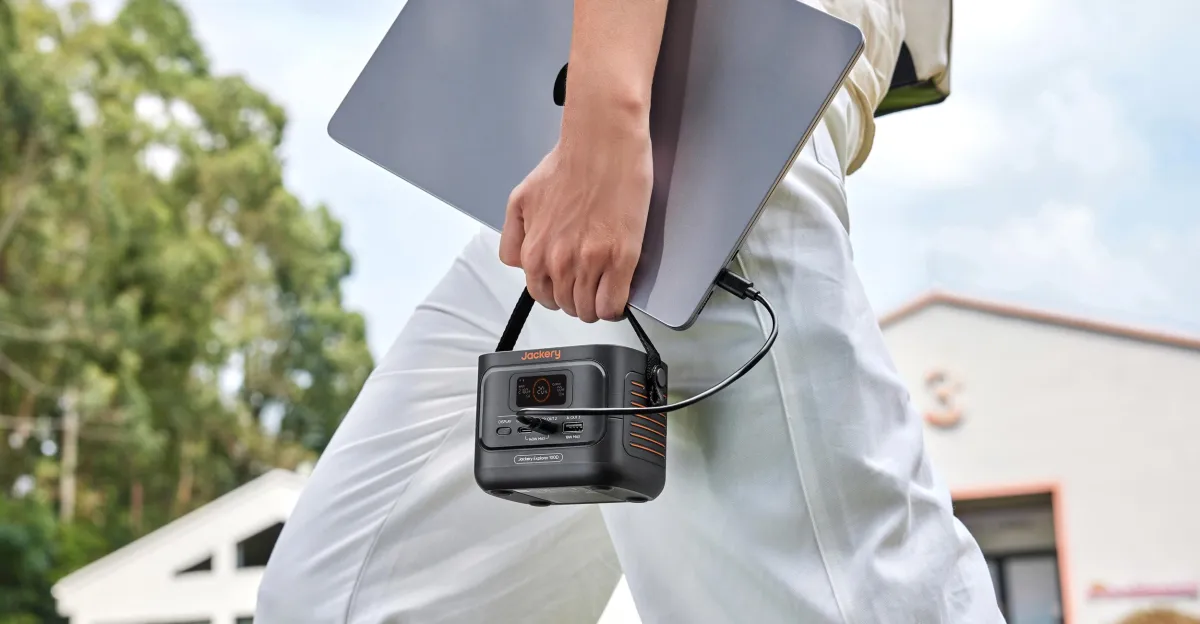
Jackery's new Explorer 100D is a neat piece of hardware. The company says it is its smallest portable power station to date, measuring 4.6 by 3.4 by 3.4 inches and weighing 1.87 pounds. With 96Wh of capacity, or 30,000mAh, it is small enough to fit in a carry-on and charge several devices on a long flight. Shrinking a power station that far is an achievement worth noting, especially for people who have been lugging heavier units around airports and campsites.
The most interesting technical choice is the lithium iron phosphate battery. Jackery says these cells are "engineered for up to 8 years of regular use" and carry a 3,000 charge cycle lifespan, figures the company attributes to its own engineering claims. Those numbers are promising, and LFP chemistry is generally known for durability and safety compared with more common lithium-ion cells. Still, the lifespan figures are the manufacturer's claims, and buyers should treat them as such until independent testing is available for this product.
Pricing and availability deserve as much attention as the battery. The Explorer 100D costs $99 at Walmart starting November 15th, and Costco already sells it, but only as a two-pack for $179.99. That bundle is a better deal per unit, yet it also means a buyer must commit to two units to get the lower price. Shoppers should compare the single-unit price with other 30,000mAh chargers, some of which are cheaper, before assuming the LFP cells justify the cost.
The power specifications also need a clear-eyed read. The unit offers two 140W USB-C ports and an 18W USB-A port, but its total output tops out at 158W, so performance drops when all three ports run together. Jackery's solar input of up to 100W, which it says can restore 80 percent charge in about an hour and a half, is useful, provided a buyer has room for a panel. Those trade-offs are not hidden, but the marketing headline about power in the palm of your hand can obscure them.
My verdict is that the Explorer 100D is a sensible product for travelers and light outdoor users who value compactness and a long-lived battery. Companies should keep making devices like this smaller and safer. Buyers, though, should weigh the bundle pricing, the shared output limit, and the lifespan claims carefully before buying. A small power station is only a good purchase when its numbers hold up in real use.