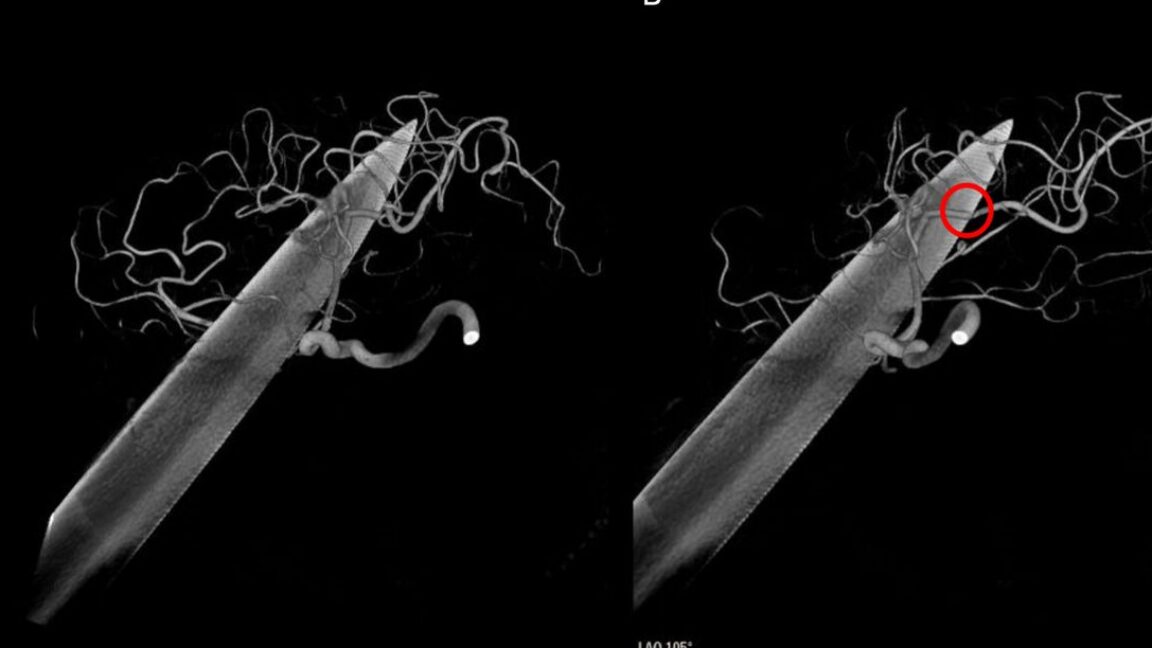
A man in his 20s arrived at a UK hospital with a knife embedded in his face, according to a report published Friday in BMJ Case Reports. The blade went through his right eye and into his brain, with its tip reaching the top of his skull.
The doctors said he was alive and conscious on arrival. He scored 12 on the Glasgow Coma Scale, which they described as a "moderate" brain injury. They sedated and intubated him because they were concerned he might pull the knife out on his own. They also gave him preventive treatment for bacterial infections, including tetanus.
Imaging showed the blade crossed the left frontal and temporal lobes. The doctors reported that it passed in front of the corpus callosum without apparently injuring it, and missed the left internal capsule. They found the blade close to the left internal carotid artery but did not think it had damaged the vessel. They did report that a branch of the middle cerebral artery appeared indented by the knife.
Surgeons removed part of his skull and used what the report calls a "pull-and-see" method to slide the blade out. They saw no significant hemorrhaging, cleaned and drained the brain wound, and replaced the skull section. His right eye could not be saved and was removed.
The man recovered quickly in intensive care. His breathing tube came out a day after surgery. He had minor right-side weakness that resolved within two days. Follow-up scans showed steady improvement, and he developed no infections or seizures. The doctors wrote that his language function was preserved and that he had no loss of movement or coordination. He was discharged and remained "neurologically well" at follow-up visits, with ongoing eye and mental health care.
The doctors said they do not know how the injury happened. "The mechanism is unclear," they wrote. They noted that he had a history of depression.
The authors said such injuries are rare and usually result from high-velocity mechanisms such as gunshots. Knives are a low-velocity mechanism, and they wrote that low-velocity penetrating brain injuries carry substantial risks of hemorrhage, infection, seizures and neurological deficit. They cited the case of Phineas Gage, a railroad foreman who survived an 1848 iron rod injury through his skull, and concluded that "outcome may depend less on external severity than on precise trajectory relative to critical vascular, cortical and subcortical structures."