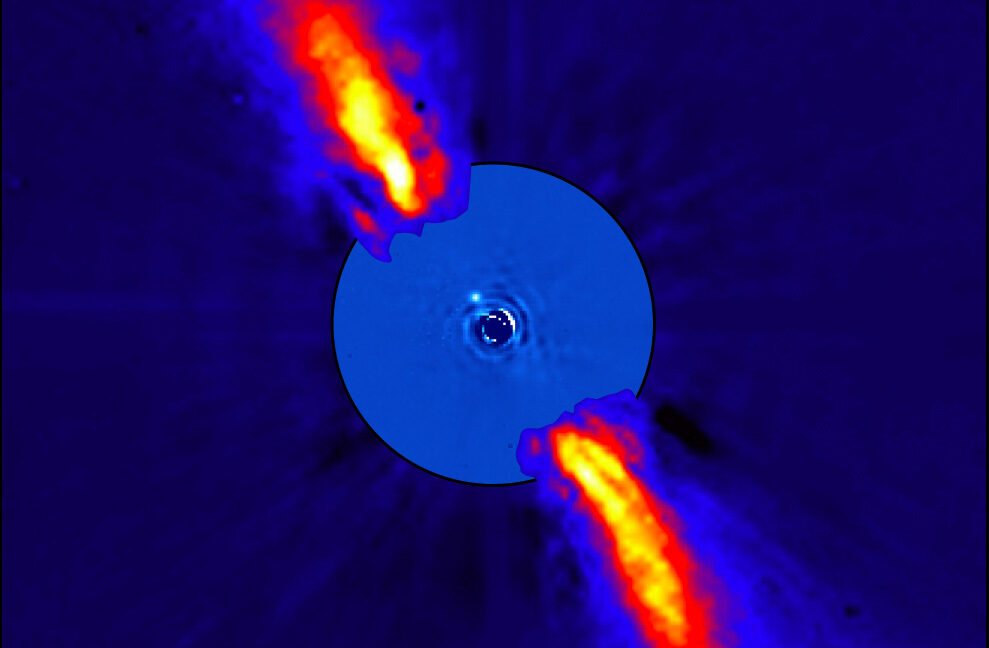
Webb telescope detects water and carbon dioxide ice around the young star Beta Pictoris, according to a new Science study led by Sarah Betti of the Space Telescope Science Institute in Baltimore. The star is roughly 20 million years old and about 64 light-years from Earth.
The team used Webb's Near Infrared Spectrograph (NIRSpec) to observe the star's debris disk on December 7, 2023. The disk is a vast ring of dust and rubble where planets are still forming, and astronomers have already found three planets there.
The researchers found that the water ice is mostly glassy, or amorphous, rather than crystalline. The team estimates that less than 7 percent of it is crystalline. The carbon dioxide is mixed into the ice at about 11 percent of the total, a proportion within the range seen in Solar System comets. According to the study, this mixing suggests the ices formed in the interstellar medium before the planets took shape.
The team argues that frequent collisions among small icy bodies called planetesimals release fresh ice and replenish the disk. The authors say this process would explain how the ice is spread so evenly across the disk. They also suggest the ingredients needed to form water-rich worlds may be common around young stars.