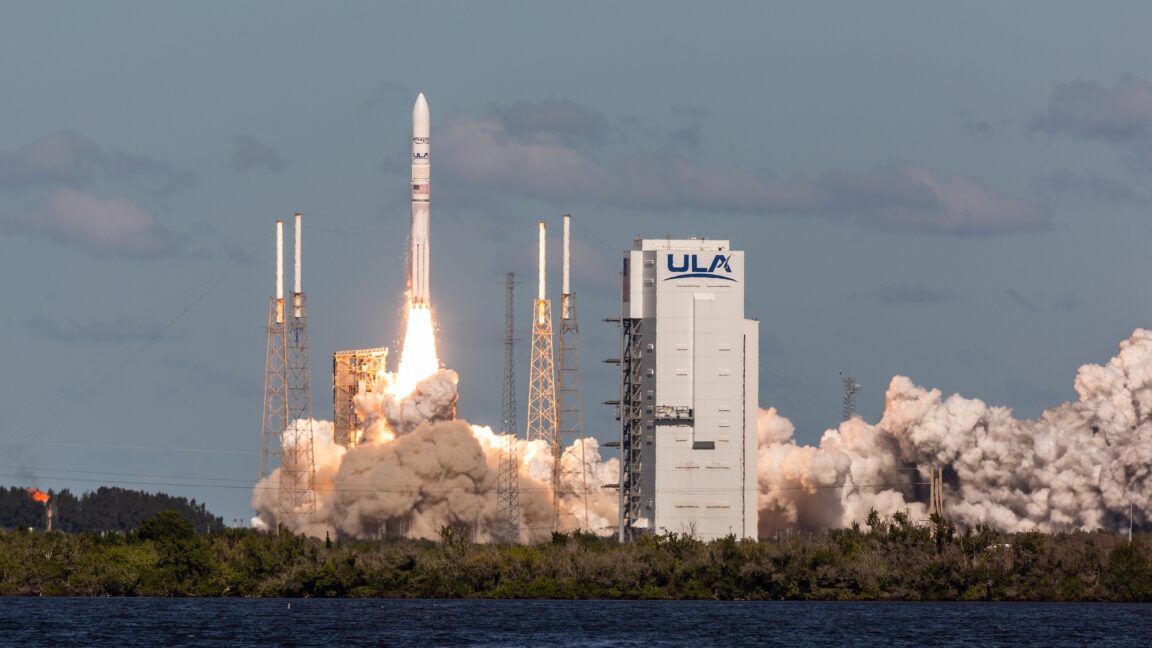
ULA's Vulcan rocket failed to deliver 40 Amazon Leo broadband satellites to orbit after liftoff Sunday from Cape Canaveral Space Force Station, Florida. The company said the rocket "suffered an anomaly 10 minutes into the flight and failed to deliver the Amazon mission to orbit." ULA said it did not immediately have "any specific data to understand what occurred."
Multiple sources told Ars Technica that the anomaly occurred in the booster stage, not the Centaur V upper stage or the solid rocket boosters. Ars Technica reported that the cause was not immediately known and could not be determined whether it involved the two BE-4 engines, another part of the booster that feeds propellant to the engines, or another problem.
According to the report, the BE-4 engines continued firing for at least 30 seconds beyond their planned shutdown, which Ars Technica said could indicate the booster was underperforming. The report said the rocket began to spin after booster engine shutdown, and the Centaur V upper stage fired its RL10 engines in an apparent attempt to correct its course.
ULA ended its live broadcast without discussing the anomaly, then declared the launch a failure on social media. ULA said it will investigate, "find the cause, determine the appropriate corrective action, and return to flight as quickly as possible." The report said the failure is expected to ground the rocket for an indefinite period.
Amazon said, "There is risk with any launch, and that's especially true for inaugural missions like LV-01," and that it believes ULA "will learn from this mission and deliver on their" commitments. The report said Amazon has 37 more Vulcan launches reserved with ULA. It also said the Amazon Leo constellation has 396 satellites in orbit, out of a planned 3,292 first-generation spacecraft.