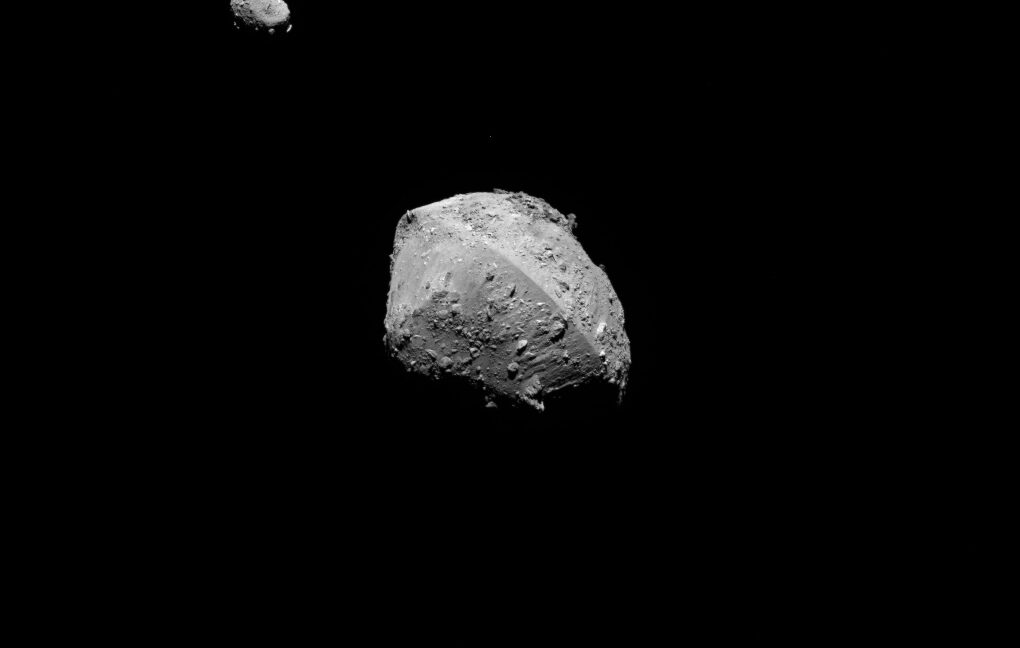
ESA's Hera spacecraft has released its first images of the crater left by NASA's DART impact on the asteroid Dimorphos. The Ars Technica report says the crater is about the size of a stadium and nearly as large as Dimorphos, which measures about 500 feet (151 meters) across.
Hera also found hundreds of boulders around the double asteroid system of Didymos and Dimorphos. According to the report, the rock fragments range from the size of a football to a washing machine. Naomi Murdoch, a planetary scientist at the Institut Supérieur de l'Aéronautique et de l'Espace in Toulouse, France, said the team "found hundreds of companions."
Scientists have not confirmed where the boulders came from. One possibility is that DART threw them off Dimorphos. Murdoch said the team needs more information before it can make that link. The boulders might also be older material from the formation of Dimorphos.
Patrick Michel, Hera's principal investigator at the Côte d'Azur Observatory in Nice, France, said the impact both cratered the asteroid and changed its shape. Michel said the team is "still not sure how this can happen."
Hera found that Dimorphos is now tumbling in its orbit, according to Michael Kueppers, ESA's Hera mission scientist. Over the next six months, Hera will move closer for more detailed observations and will release two small sub-satellites to attempt landings on Dimorphos. The report says the boulder field could complicate navigation for those CubeSats, which are scheduled for deployment in January. Margherita Cardi, project manager for the Milani CubeSat, said, "There is a mix of excitement and panic."