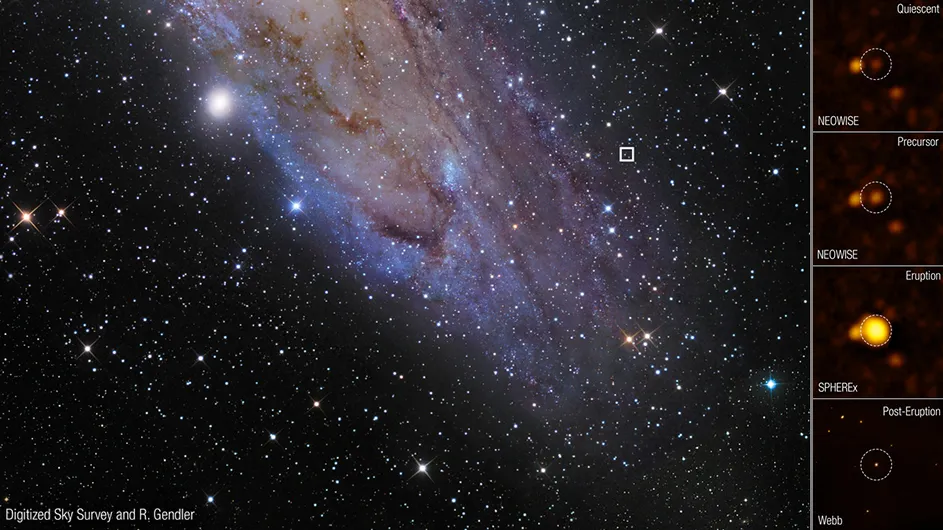
Astronomers watched a giant star in the Andromeda Galaxy swallow a smaller companion and erupt in late 2025, according to a new study in Nature led by Viraj Karambelkar, an astrophysicist at Columbia University. The process is called common envelope evolution.
The researchers identified the system, named AT 2025abao, while searching Andromeda for stars that change in brightness. They used the Wide-field Infrared Transient Explorer (WINTER) telescope at Palomar Observatory and data from NASA's NEOWISE mission. In April 2025, the team published a paper suggesting the system was undergoing an engulfment. At that point, they could not rule out a competing explanation involving instabilities in the giant's core.
The team reconstructed the system's history using observations from about a dozen telescopes and surveys, including photographic sky plates from 1989. The giant star was about 350 times wider than the Sun for years before 2018. Its companion could not be seen directly, so the team estimated its mass at roughly 0.7 solar masses based on dust the system had shed.
Between 2018 and early 2025, the giant brightened two- to threefold in visible light. Karambelkar said the companion's inward spiral heated the giant's outer envelope, and the energy released matched the extra light. NASA's SPHEREx telescope observed the star in July 2025, when it had swollen to about 860 times the Sun's width.
In October 2025, the star brightened roughly 100-fold in 25 days. Karambelkar said the companion plunged into the core, and that "violent crash" set off the eruption. The event resembled a luminous red nova, a type of outburst previously linked to merging stars. Karambelkar said previously known luminous red novae came from younger stars, while this one came from an old giant with a loose envelope.
The researchers estimated how the released energy was distributed. Most energy escaped as light during the slow spiral. During the final plunge, about 1 percent of the energy was radiated, and most went into ejecting roughly a tenth of the envelope. The team concluded the companion most likely merged with the giant's core rather than surviving as a tight partner.